
How to Know if You’ve Found the Very Rare Vintage Corningware L’Echalote, La Marjolaine at Goodwill
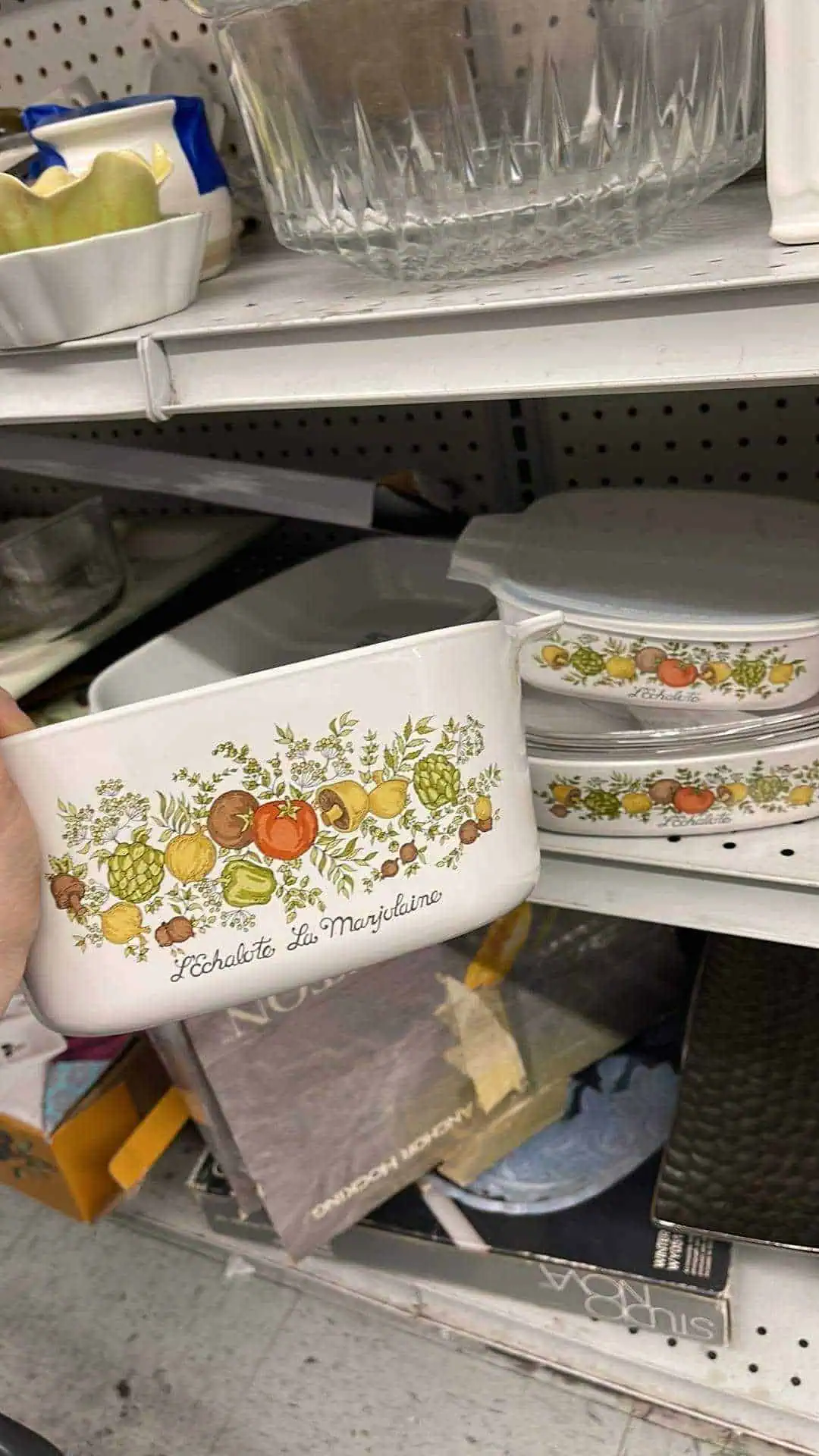
Finding a rare treasure in the “glassware” aisle of Goodwill is the ultimate thrifter’s high. You’re scanning past the chipped mugs and the scratched-up plastic storage containers when suddenly, you see it: a flash of earth-toned vegetables and French script.
Could it be? The legendary L’Echalote, La Marjolaine?
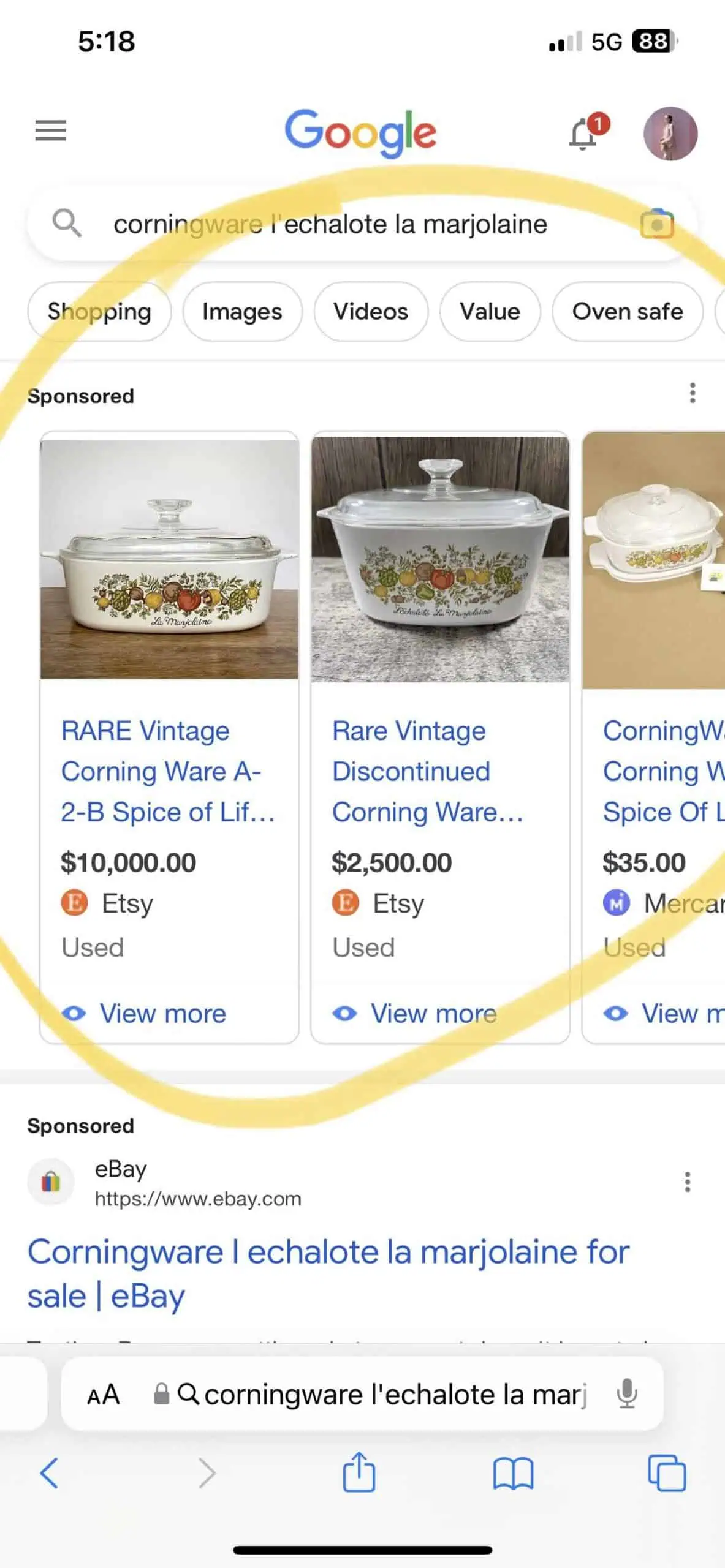
There is a massive amount of misinformation (and “delusional” pricing) floating around regarding this specific CorningWare pattern. To strike gold at a thrift store, you need to know exactly what you’re looking at, how to separate the common from the “holy grail,” and why the price tags on eBay can range from $10 to $10,000.
Here is the definitive guide to identifying, dating, and valuing the rare CorningWare L’Echalote, La Marjolaine.
Table of Contents
1. The Anatomy of the Pattern: Spice O’ Life vs. L’Echalote
The first thing you must understand is that L’Echalote (The Shallot) and La Marjolaine (The Marjoram) are part of the larger Spice O’ Life series.
Introduced in 1972, Spice O’ Life was the second most produced pattern in Corning history (after Blue Cornflower). Because it was mass-produced for 15 years, it is incredibly common at Goodwill. Most of what you find is worth about $15 to $30.
What makes it “Rare“?
The truly collectible pieces are the early production runs from the first few years (roughly 1972–1975). These pieces feature:
- The Script: The names of the vegetables or herbs (like L’Echalote or La Marjolaine) are written in a delicate, cursive French script directly under the vegetable band.
- The Markings: They often feature specific stamps on the bottom that indicate they were produced before the manufacturing process was streamlined.
2. The Goodwill “Hit List”: How to Spot the Winners
When you’re standing in the aisle, don’t just look at the design—flip the dish over. The backstamp (the markings on the bottom) is the “DNA” of the dish.
The “A-Series” Backstamp
Look for the model number. Vintage CorningWare used a letter-prefix system:
- P-Series (1960s–1972): These have small, narrow handles. If you find a Spice O’ Life with a “P” prefix, it’s an early 1972 piece and worth snagging.
- A-Series (1972–1980s): Most Spice O’ Life pieces are A-Series (e.g., A-1-B, A-2-B, A-3-B). These have wider, more comfortable handles.
The Hologram Stamp
One of the surest signs of a “first generation” Spice O’ Life piece is the hologram stamp. These were used between 1972 and 1979. Unlike the bold blue or black ink stamps, these are etched into the ceramic and are often invisible unless you tilt the dish toward the light. If you find an L’Echalote with a hologram stamp, you’ve found a true vintage original.
The “Hidden” Number 8
In some extremely rare cases, collectors have found L’Echalote pieces with a small number “8” displayed on the bottom right of the vegetable pattern itself (not the backstamp). This is believed to be a very early production code and is highly sought after by completionist collectors.
3. Rare Shapes to Look For
While square casserole dishes are a dime a dozen, certain shapes in the L’Echalote/La Marjolaine pattern are genuinely rare:
| Piece | Why it’s Rare | Estimated Value |
| 5-Liter Casserole (A-5-B) | Huge and less common; perfect for large family gatherings. | $100 – $200 |
| Round Servers | Most Spice O’ Life is square. Round versions were only made for a short window (1973–1975). | $50 – $90 |
| Percolators | Because of a massive recall in the 70s, many were thrown away. | $40 – $150 |
| Browning Skillets | Look for the “MW” (Microwave) prefix or a textured, tinted bottom. | $30 – $60 |
4. The $10,000 Myth: A Word of Caution
If you search for “L’Echalote” on eBay, you will see listings for $5,000, $7,000, or even $15,000. Do not be fooled.
There is a long-standing “laundry room” legend that these dishes are worth thousands. This usually stems from “money laundering” listings or sellers hoping to catch an uneducated buyer.
- The Reality: The actual “sold” prices for these pieces (even the rare ones) usually top out between $100 and $500 for pristine, rare sets.
- The Exception: True “flaw” pieces (rare factory misprints) or prototypes can occasionally fetch high prices from niche collectors, but they are not the norm.
5. Identifying the Material: Pyroceram vs. Stoneware
Before you buy that “vintage” find, check the texture.
- Pyroceram (The Real Deal): This is a glass-ceramic material. It feels smooth, like glass, and is remarkably white. It is “Range-to-Table,” meaning you can take it from the freezer to a gas burner without it shattering.
- Stoneware (The Modern Remix): In the late 90s/2000s, CorningWare began making glazed stoneware. It is heavier, the bottom is usually unglazed and rough, and it will explode if put on a stovetop.
True L’Echalote/La Marjolaine pieces are almost always Pyroceram. If the bottom of the dish feels like a ceramic coffee mug, it’s a later reproduction or a different line.
6. How to Inspect for Damage
Goodwill isn’t always kind to its inventory. Before you head to the register, perform these three checks:
- The “Ping” Test: Tap the side of the dish with your fingernail. It should produce a clear, bell-like ring. A dull “thud” might indicate a hairline crack.
- The Grey Scuff Test: Look for grey lines. These are metal marks from spoons or whisks. They aren’t permanent! You can usually remove them with Bar Keepers Friend.
- The Lid Fit: Make sure the lid is original Pyrex (it will usually be marked A-9-C or similar). A mismatched lid significantly lowers the value.
Summary: The Goodwill Checklist
Next time you’re at the thrift store, keep this mental checklist:
- Does it have the script? Look for L’Echalote or La Marjolaine in cursive.
- Is it A-Series or P-Series? Check the backstamp for “A-1-B” or “P-1-B”.
- Is the stamp a hologram? Tilt it in the light to see if the mark is etched.
- Is it Pyroceram? Make sure it feels like smooth glass, not heavy pottery.
Finding a rare piece of L’Echalote is like finding a piece of kitchen history. It’s durable, beautiful, and—if you find it at Goodwill—a massive bargain.
See More Guides to Vintage Collectibles:
Subscribe
Sign up for our newsletter!
Never miss a thrifting tip! Readers of our newsletter will receive notifications of new published blog posts and exclusive content just for our loyal readers.